)
Our Responsibility
Taking Responsibility Through Clear Climate Goals
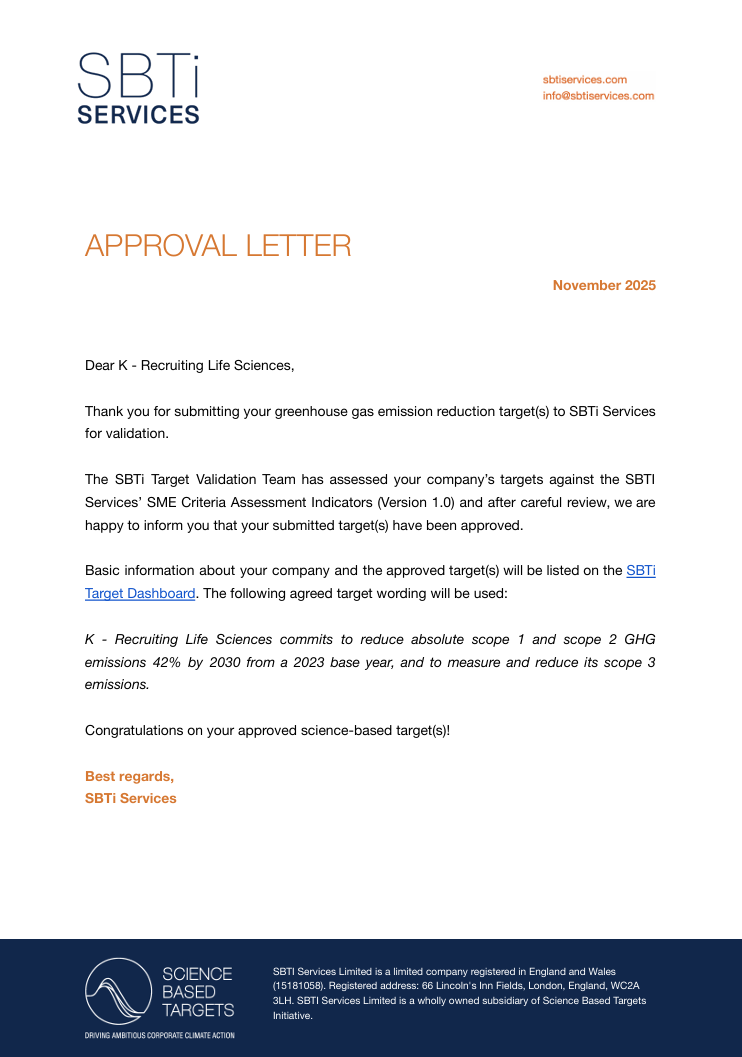
"K-Recruiting Life Sciences commits to reduce absolute scope 1 and scope 2 GHG emissions 42% by 2030 from a 2023 base year, and to measure and reduce its scope 3 emissions."
K-Recruiting Life Sciences is striving to reduce its absolute Scope 1 and Scope 2 emissions by 42% by 2030 compared to the 2023 baseline year. In addition, we will systematically track our Scope 3 emissions, increase transparency, and reduce them.
This target was validated by the Science Based Targets initiative (SBTi) in November 2025 and classified as 1.5°C-compatible.
)
The Science Based Targets initiative (SBTi) is a global partnership between CDP, the United Nations Global Compact, the World Resources Institute (WRI), and the World Wide Fund for Nature (WWF). The SBTi develops standards, tools, and guidelines to help companies reduce their greenhouse gas emissions in line with what climate science requires to limit global warming to 1.5°C and achieve net-zero by 2050 at the latest. Companies such as K-Recruiting Life Sciences have their targets independently verified and classified by the SBTi to ensure that their climate action is science-based and comparable.
What Our Science Based Target Means in Practice
A validated target is not an end in itself. For K-Recruiting Life Sciences, it means consistently aligning our business operations with measurable emissions reductions.
In short: We reduce before we offset – in line with the SBTi’s requirements.
Scope 1:
We are constantly working to reduce the direct emissions generated by our business operations. To this end, we focus on the efficient use of our office space, the optimization of our energy consumption, and measures to improve energy efficiency at our locations.
Scope 2:
Our goal is to sustainably reduce emissions from purchased energy. To this end, we source electricity from renewable energy sources and make a conscious effort to use energy efficiently and conserve resources in our day-to-day operations.
Scope 3:
We also aim to gradually reduce emissions throughout our value chain. That is why we promote flexible work models, take a critical look at business travel, and consider sustainability factors in our procurement practices.
Our Roadmap Through 2030
To achieve our SBTi-validated target, we have established a clear framework for the coming years:
We will review our progress annually and adapt our measures to reflect new scientific findings and regulatory developments.
Accountability, Governance, and Transparency
By achieving our climate goals, we create long-term value – for our company, our employees, and our partners.
Through transparent, responsible, and forward-looking measures, we are strengthening sustainable collaboration and would like to encourage our partners to join us on this journey and actively contribute to a more sustainable future.